# NXP Platform LoRaWAN Edge Gateway
Shenzhen Winext Technology Co., Ltd. Shenzhen Winext Technology Co., Ltd.
Custom Services:
- Neutral (white-label) gateway firmware provided free of charge
- Custom sensor integration for third-party devices available (paid)
- SSH credentials provided for orders of 10+ gateways
- Bilingual online documentation for self-deployment available (paid)
- Bilingual LoRaWAN sensor documentation for self-deployment available (paid)
1 Product Introduction
1.1 Product Advantages
1.1.1 High-Performance Processor Platform
- Industrial-grade NXP i.MX93 tri-core processor (Dual-core Cortex-A55 @ 1.7 GHz + low-power Cortex-M33 @ 250 MHz)
- Integrated NPU (Neural Processing Unit) delivering 0.5 TOPS, supporting edge AI applications
- 2 GB LPDDR4 RAM + 32 GB eMMC storage for smooth system operation
1.1.2 Double LoRa Channel Capacity
- 16 uplink channels + 2 downlink channels — double the capacity of the 8-channel GW8000
- Supports higher concurrent device density, reduces packet loss, and improves network efficiency
- Dual SX1302 RF architecture, receive sensitivity down to −142 dBm
1.1.3 Diverse Connectivity Options
- 4G LTE multi-band (supports both domestic and international bands)
- Dual-band WiFi (2.4 GHz/5.8 GHz, 2×2 MIMO)
- Dual Ethernet (WAN Gigabit + LAN 100 Mbps)
1.1.4 Built-in Network Server
- Pre-installed ChirpStack V4.19.0 network server for local device management
- No external cloud platform required for LoRaWAN device onboarding and data collection
- Regularly updated to the latest ChirpStack release
1.1.5 Rich Protocol Support
- LoRa Protocol:UDP GWMP、MQTT、Basic Station(LNS/CUPS)、chirpstack-mqtt-forwarder
- Data push protocol: MQTT v3.1.1, HTTP, Modbus TCP, BACnet BIP
- Supports connection to external NS (TTN, ChirpStack, Microsoft Azure, AWS, etc.)
1.1.6 Industrial-Grade Reliability
- IP67 ingress protection, suitable for harsh outdoor environments
- Operating temperature −40 °C to +75 °C, humidity 5 %–95 % RH
- External TI industrial-grade hardware watchdog for stable operation
- Built-in low-power, high-precision NXP RTC chip + CR2032 backup battery for offline time-keeping
- Built-in u-blox M10 series GPS/BeiDou/Galileo/GLONASS multi-mode positioning module with GPS/BeiDou precision time sync
- Super-capacitor backup power for safe eMMC data flush on power failure, plus power-loss alert
1.1.7 Flexible Deployment and Management
- Supports PoE (IEEE 802.3at/af) power, simplifying installation wiring
- Wall-mount and pole-mount kits provided
- Supports solar + UPS power kit
1.1.8 Customization and Development Support
- Python 3.11 scripting support for custom data processing logic
- IoT Hub supports Thing Model TSL (Thing Specification Language) definition for flexible configuration of device attribute fields
- Supports cluster management and device roaming feature
- Supports custom JavaScript payload parsers
- OpenWrt-based system with Chinese/English UI support
1.1.9 LBT (Listen-Before-Talk) Spectrum Sensing Technology
- Regulatory Compliance: Meets spectrum-sharing regulations in Europe (EU868), Asia (AS923, KR920), and other regions
- Intelligent Avoidance: Devices listen for channel RSSI before transmitting, detecting whether the channel is busy to avoid collisions
- Improved Network Efficiency: Significantly reduces packet collisions and retransmissions in dense deployments, increasing network throughput
- Beyond ALOHA: LBT improves network performance by 30–50 % compared to traditional random access
- Hardware-Level Support: Implemented in SX1302 + SX1262 hardware for fast response and lower power than SX1301-based solutions
- Applicable bands: Fully supports AS923-1/AS923-2/AS923-3/AS923-4, KR920, EU868; also compatible with RU864 and IN865
- Note: US915 and AU915 bands use BW500 KHz for downlink, while LBT only supports BW125 KHz; therefore LBT is not supported on these bands
1.1.10 Comprehensive Data Traceability
- Real-time Data Query: Retrieve ChirpStack standard protocol data and IoT Hub decoded data in real time via HTTP API
- Historical Data Search: Query history by latest record count or by time range
- Multi-dimensional Logging: Records LoRaWAN frame details, raw payload (Base64 + Hex), and decoded JSON data
- Excel Data Export: One-click export of historical data to Excel for offline analysis and audit
- Offline Data Cache: Data is automatically cached during network outages and relayed once connectivity is restored, ensuring no data is lost
- Data Integrity: Every LoRaWAN frame is fully preserved, including uplink, downlink, join, and acknowledgement events
- Fast Retrieval: PostgreSQL-indexed queries return large volumes of historical data in seconds
- Application Scenarios: Fault investigation, device debugging, data audit, compliance inspection, and more
1.1.11 FUOTA Remote Firmware Upgrade Capability
- No On-Site Operation Required: Upgrade device firmware remotely over the LoRaWAN network, saving labor and time
- LDPC Forward Error Correction: Advanced LDPC algorithm tolerates 20–30 % packet loss
- Batch Upgrade: Supports multicast mode, enabling simultaneous upgrades of hundreds of devices
- Standard Protocol: Based on LoRa Alliance standards, compatible with a wide range of LoRaWAN end devices
- Application Scenarios: Bug fixes, feature upgrades, security patches, and large-scale device maintenance
1.1.12 Remote Management Support
- Supports VPN authorization to establish an encrypted tunnel for remote gateway access, facilitating remote maintenance and technical support
- Supports unattended remote access to the gateway LuCI page, built-in ChirpStack page, ChirpStack REST API page, and Node-RED page
1.2 NXP Gateway Specification Comparison
| Parameter | LoRa 16-Channel Version | LoRa 8-Channel Version |
|---|---|---|
| Model | GW8016 | GW8000 |
| CPU | NXP i.MX93 dual high-performance cores + 1 low-power CPU | NXP i.MX93 dual high-performance cores + 1 low-power CPU |
| Processor Architecture | Dual ARM® Cortex™-A55 + Cortex-M33, i.MX93 up to 1.7 GHz, Cortex-M33 250 MHz | Dual ARM® Cortex™-A55 + Cortex-M33, i.MX93 up to 1.7 GHz, Cortex®-M33 250 MHz |
| NPU | Neural Processing Unit: up to 0.5 TOPS | Neural Processing Unit: up to 0.5 TOPS |
| RAM | 2 GB LPDDR4 | 1 GB LPDDR4 |
| Flash | eMMC 32 GB | eMMC 8 GB |
| Power (PoE) | Standard PoE power, IEEE 802.3at/af | Same as left |
| Power Supply (DC) | DC 12~24 V/2A | DC 12~24 V/2A |
| Software System | openwrt-24.10 | openwrt-24.10 |
| Linux Kernel | linux-6.6.52 | linux-6.6.52 |
| LoRa main chip | SX1302 (SX1303 with LoRa geolocation available on request) | SX1302 (customizable to SX1303 with LoRa geolocation) |
| LoRa Operating Band | CN470-510 / EU863-870 / US902-928 / AS923-1/2/3/4 / AU915-928 / KR920-923 / RU864-870 / IN865-867 | Same as left |
| LoRa Data Rate | 292 bps – 5.4 kbps; SF7–SF12 (LoRaWAN), SF5/SF6 (proprietary) | Same as left |
| LoRa transmit power | 10 / 14 / 16 / 17 / 20 / 23 / 25 / 27 dBm | Same as left |
| LoRa full-duplexsupportband | CN470-510 | CN470-510 |
| LoRa receive sensitivity | -141.5 dBm @ SF12(half-duplex) / -141 dBm @ SF12(full-duplex) | Same as left |
| LoRa Noise Floor Scan | support | support |
| LoRa Antenna | 2 × 5 dBi fiberglass antennas | 1 × 5 dBi fiberglass antenna |
| LoRa antenna type | Omnidirectional | Omnidirectional |
| LoRa LBT | support | support |
| LoRa channel | 16 uplink / 2 downlink | 8 uplink / 1 downlink |
| 4G LTE Standard | U9300C (China) module tri-network bands: | |
LTE-TDD : B38/B39/B40/B41 LTE-FDD: B1/B3/B5/B7/B8 TD-SCDMA: B34/B39 UMTS: B1/8 EVDO: 800MHz CDMA1x: 800MHz GSM: 850/900/1800/1900 EC25-E(Region: EMEA/South Korea/Thailand/India)module supports the following bands: FDD LTE: B1/B3/B5/B8/B20 TDD LTE: B38/B40/B41 WCDMA: B1/B5/B8 GSM: B3/B8 EC25-AF(Region: North America)module supports the following bands: FDD LTE: B2/4/5/12/13/14/66/71 WCDMA: B2/B4/B5 EC25-AU(Region: Latin America/Australia/New Zealand)module supports the following bands: FDD LTE: B1/B2/B3/B4/B5/B7/B8/B28 TDD LTE: B40 WCDMA: B1/B2/B5/B8 GSM: B2/B3/B5/B8 EG25-G(Region: Global)module supports the following bands: FDD LTE: B1/B2/B3/B4/B5/B7/B8/B12/B13/B18/B19/B20/B25/B26/B28 TDD LTE: B38/B39/B40/B41 WCDMA: B1/B2/B4/B5/B6/B8/B19 GSM: B2/B3/B5/B8 |
Same as left | |
| Outdoor Positioning | u-blox MAX-M10S, GPS/BeiDou/Galileo/GLONASS multi-constellation | Same as left |
| Gateway Time Sync | Built-in PCF85263 RTC + CR2032 button cell for offline time; GPS; NTP sync | Same as left |
| Power-Loss Alert | Custom 5.5 V/7.5 F super-capacitor for power-loss alert | Custom 5.5 V/7.5 F super-capacitor for power-loss alert |
| Hardware Watchdog | External TI industrial-grade watchdog | External TI industrial-grade watchdog |
| Wi-Fi | AP6398S 2T2R 802.11 ac/a/b/g/n; 2.4 GHz/5.8 GHz; default AP mode, also supports STA client mode | Same as left |
| BT | AP6398S built-in BT5.2 module; reserved for app configuration | BT5.2 reserved for app configuration |
| Antenna Connectors | 5 | 4 |
| RJ45 Ethernet Port | Two ports: WAN Gigabit (PoE), LAN 100 Mbps | Same as left |
| IP Rating | IP67 | IP67 |
| Operating Temperature | -40℃ ~ +75℃ | -40℃ ~ +75℃ |
| Operating Humidity | 5 %–95 % RH, non-condensing | Same as left |
| Installation Method | Wall-mount and pole-mount kits; antenna support for coaxial extension | Same as left |
| Dimensions | 288 mm × 215 mm × 59 mm (gateway) 486 mm × 400 mm × 150 mm (packaging) |
Same as left |
| Certification | Inherits FCC/CE certification from GW5000; FCC ID: 2AFI2GW0001 | Same as left |
1.3 Hardware Version Description
The IMX93-GW8016 gateway series offers 3 hardware versions, each targeting different frequency bands and regional requirements:
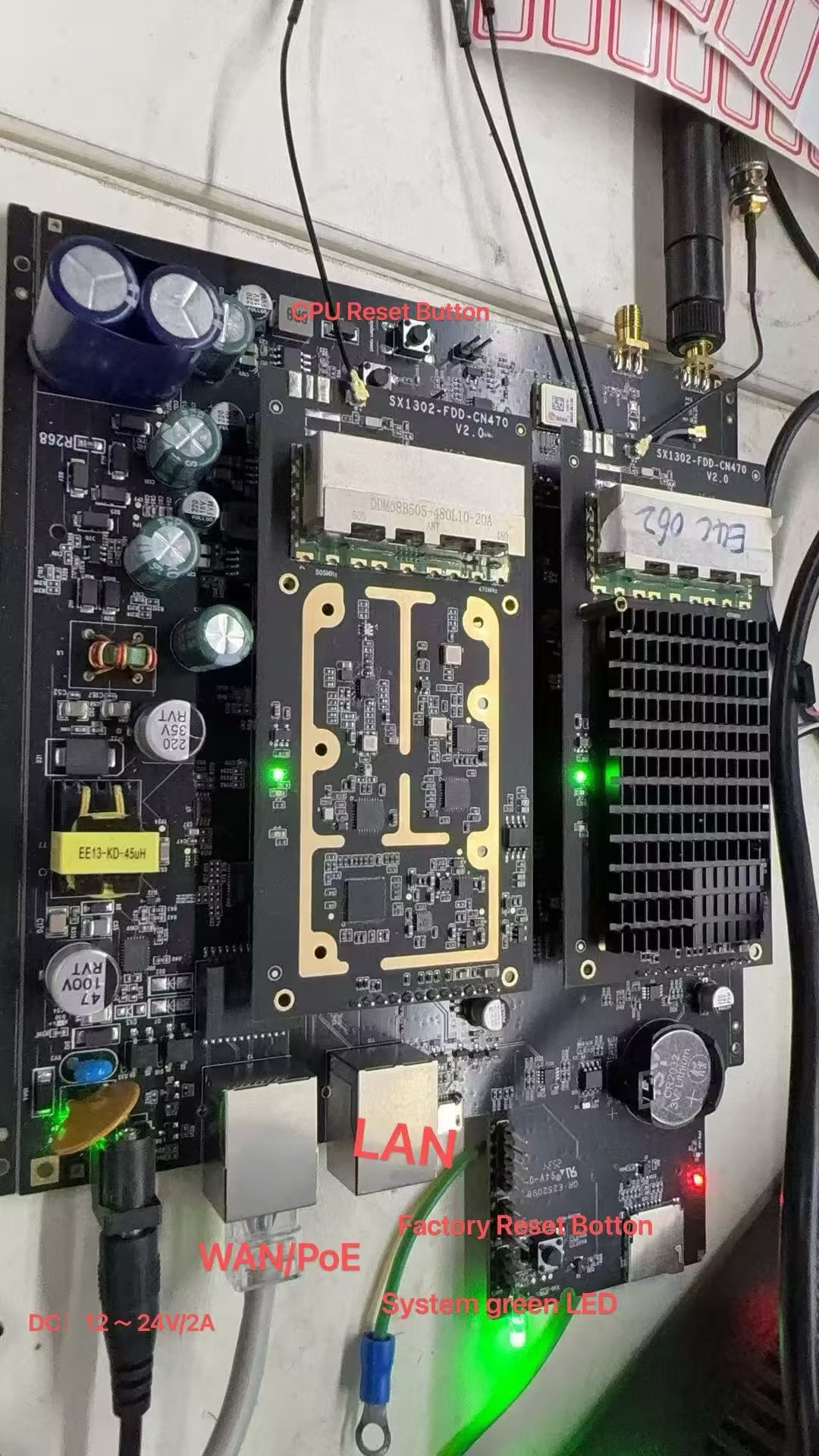
1.3.1 Gateway Internal Hardware Interface Overview
- Internal components:
- WAN: Supports Gigabit speed, 48V PoE power; default DHCP client; connects to the Internet/WAN and upstream server
- LAN: Default DHCP server; assigns 192.168.60.x addresses to connected PCs for configuration
- DC: 12V to 24V / 2A power supply; absolute voltage limits: 9V–28V
- Software Factory Reset Button: Long press (>6 s) causes the system LED to flash; release to factory reset. Short press triggers a system reboot.
- Hardware CPU Reset Button (labeled "system reset"): Press once to perform a hardware CPU reset.
1.3.2 CN470 Full-Duplex Version
Target Region: Mainland China
RF Architecture:
- Based on the official reference design: SX1302CFD490GW1_e537v03a
- Two SX1302 radio boards integrated, each using the official SX1302 + 2×SX1255 + SX1262 full-duplex reference design
- Operating mode: Full-duplex using a duplexer for TX/RX isolation
Frequency Range:
- Receive Frequency Range:470MHz ~ 490MHz
- Transmit Frequency Range:500MHz ~ 510MHz
LBT Functionality:
- LBT is not enabled. LoRa LBT (Listen Before Talk) is a key LoRa/LoRaWAN mechanism that allows devices to check whether a channel is clear (by measuring RSSI) before transmitting, preventing collisions, improving efficiency in dense environments, and meeting regulatory requirements (e.g., Japan/Korea) for shared spectrum — pushing network performance well beyond basic ALOHA.
- In CN470 band, SX1262 is used for noise-floor scanning only
Protocol Compatibility:
- Supports CN470 channels as defined by the LoRaWAN V1.0.3 standard
- Does not support V1.0.4 channels (V1.0.4 channels were modified by Alibaba)
1.3.3 EU868 LBT Version
Target Region: European Union, Russia, India, and similar regions
RF Architecture:
- Based on the official reference design: SX1302CSS868GW1_e539v03a
- Two SX1302 radio boards integrated, each using the official SX1302 + 2×SX1250 + SX1262 LBT reference design
- Operating mode: half-duplex, with full LBT functionality supported
LBT Functionality:
- All LBT (Listen Before Talk) features are enabled in the EU868 band, while retaining noise floor scanning capability
Band Switching:
- EU863-870
- RU864-870 (Russia)
- IN865-867
1.3.4 US915/AS923 LBT Version
Target Region: United States, Australia, Japan, South Korea, Southeast Asia, South America, and similar regions
RF Architecture:
- Based on the official reference design: SX1302CSS915GW1_e539v03a
- Two SX1302 radio boards integrated, each using the official SX1302 + 2×SX1250 + SX1262 LBT reference design
- Operating mode: half-duplex, with full LBT functionality supported
LBT Functionality:
- All LBT (Listen Before Talk) features are enabled in the AS923 and KR920 bands, retaining noise floor scanning capability
Band Switching:
- US902-928 (United States)
- AU915-928 (Australia, South America)
- AS923-1 (Japan, Singapore, etc.)
- AS923-2 (Vietnam)
- AS923-3 (Indonesia)
- AS923-4 (Israel)
- KR920-923 (South Korea)
1.4 Software Feature Overview
The gateway software system is based on OpenWrt-24.10, with a kernel derived from NXP's official linux-6.6.52 branch. It supports a rich set of protocols and feature modules:
1.4.1 LoRa Network Protocol Support
- ChirpStack V4.x: Built-in full ChirpStack network server, regularly updated to the latest version, supports local device management
- UDP GWMP Protocol: Connect to external network servers (e.g., TTN, ChirpStack, lorawan-stack, and other open-source projects)
- MQTT Protocol:support chirpstack-mqtt-forwarder Protocol,compatible IoT Vision
- Basic Station Protocol:
- LNS mode: Supports connection to TTN, ChirpStack, Microsoft Azure IoT, and other platforms
- CUPS Mode: Supports AWS IoT Core for LoRaWAN; automatically retrieves the LNS endpoint and TLS certificate via HTTPS
1.4.2 Built-in ChirpStack v4.19.0
- Built-in NS Parsing and Data Push: The built-in ChirpStack network server supports multiple push methods (integrations) for device data
- MQTT v3.1.1 push and subscribe
- HTTP push
- AWS SNS
- Azure Service-Bus
- Blynk
- GCP Pub/Sub
- IFTTT
- InfluxDB
- myDevices
- Pilot Things
- ThingsBoard
1.4.3 IoT Hub Thing Model Aggregation and Multi-Protocol Mapping
- IoT Hub manages the thing model and establishes mapping between low-speed LoRaWAN devices and high-speed TCP/IP protocols
- HTTP GET to query real-time data and historical data
- Modbus TCP Protocol (supports configuring port and slave ID)
- BACnet BIP Protocol (UDP-based; supports configuring device object ID)
1.4.4 Custom Development and Extensions
- White-label gateway interface (no Winext logo): Supports neutral Chinese/English UI; retains ChirpStack open-source project branding
- Python 3.11: Supports writing custom Python 3 scripts for data processing and complex business logic
- ubus (OpenWrt): System-level message bus facilitating inter-process communication and system integration
- ZMQ: Message queue providing real-time data communication interfaces between ChirpStack and the IoT Hub
- JS Payload Parser: Supports writing custom JavaScript to parse LoRaWAN payload data
- Node-RED: Supports writing custom data-processing Node.js scripts via the Node-RED flow editor
- IoT Hub: Supports TSL (Thing Specification Language / Thing Model) definition for flexible configuration of device attribute fields
1.4.5 Easy Maintenance
- Excel batch operations: Supports Excel import/export of devices and historical data export
- Cluster management: Supports multi-gateway cluster deployment and device roaming feature
- Secure Remote Access: Built-in VPN support for remote technical support and maintenance
- Device Remote FUOTA: Remote firmware upgrade for LoRaWAN devices; limited to UniTalk's LoRaWAN Class C devices
1.5 System Architecture
The IMX93-GW8016 gateway uses a modular software architecture where components communicate through standardized interfaces (ubus, ZMQ, gRPC), achieving high cohesion and low coupling. The complete system architecture is shown below:
1.5.1 System Architecture Description
1.5.1.1 Hardware Layer
Dual SX1302 RF Architecture:
- Each SX1302 chip communicates via a dedicated SPI bus (SPI1/SPI6)
- Each SX1302 is paired with an SX1262 auxiliary chip communicating via SPI chip select (CS0/CS1)
- Each SX1302 is equipped with an HDC2010 temperature sensor chip; LoRa RSSI is calibrated against real-time temperature via I2C
- Each SX1302 is equipped with an AD5338R DAC chip that controls the PA power chip RF5110G; max output power 27 dBm via I2C
- SX1262 performs noise floor scanning (all bands) and LBT (EU868, AS923, KR920 bands)
- Hardware supports 16 uplink channels and 2 downlink channels
1.5.1.2 LoRa Driver Layer
lora process features:
- Directly operates SX1302 and SX1262 hardware to handle LoRa physical-layer communication
- Read/write SX1302/SX1262 registers via SPI bus to configure RF parameters, perform noise floor scanning and LBT detection
- Reads/writes HDC2010 and AD5338R via the I2C bus
- Provides two communication interfaces:
- ubus interface: Used by the OpenWrt LuCI page to query LoRa status (RSSI, SNR, packet statistics)
- ZMQ Interface: High-performance data channel
1.5.1.3 Protocol Forwarder Layer
fwd process features:
- Subscribe to LoRa process uplink data and publish downlink data via ZMQ
PUB/SUB - Implements multiple LoRa protocol conversions and packet forwarding:
- UDP GWMP: Semtech standard protocol; connects to TTN, lorawan-stack, and other external NS platforms
- MQTT: Connects to IoT Vision and similar platforms
- chirpstack-mqtt-forwarder: Connects to external or built-in ChirpStack NS
- Basic Station:
- LNS mode: Connects to ChirpStack, TTN, Microsoft Azure via WebSocket (WSS)
- CUPS mode: Connect to AWS IoT Core via HTTPS to automatically retrieve the LNS configuration and certificate
1.5.1.4 Network Server Layer
chirpstack process features:
- Full-featured LoRaWAN network server (currently ChirpStack V4.19.0) built into the gateway
- Communicates with the fwd process via ZMQ
ROUTER/DEALERto implement the chirpstack-mqtt-forwarder protocol - Core features:
- Device join management (OTAA/ABP)
- LoRaWAN frame parsing and validation
- Device session management and data decryption
- Multi-gateway cluster support and device roaming
- Custom JavaScript decoder
1.5.1.5 Database Layer
PostgreSQL Database:
- ChirpStack database: Device information, application configuration, gateway registration, and ChirpStack session data
- iot database:
- Device history table: Parsed device data, supporting time-range queries and Excel export
- Thing model table: Thing Model TSL (Thing Specification Language) definitions — attributes, events, services
- Device shadow table: Caches the latest device status
- MQTT cache table: Caches data when MQTT is offline; relays automatically after network recovery
Redis Cache:
- Device status cache: last online time, battery level, signal strength
1.6 Competitive Advantage Summary
Based on the feature analysis above, the IMX93-GW8016 gateway offers significant competitive advantages in the following areas:
1.6.1 Technical Leadership
- Dual SX1302 Architecture: 16 channel capacity — twice that of standard 8-channel gateways
- NXP i.MX93 Processor + NPU: Supports Edge AI applications
- Full-duplex support: CN470 band full-duplex mode, receive sensitivity: -141 dBm
- Half-duplex support: EU868/US915/AS923 band half-duplex mode, receive sensitivity: -141.5 dBm
1.6.2 Ease of Use
- Zero-code configuration: All features configurable via the Web interface
- Batch device management: Excel import/export, supports large-scale deployment
- One-click protocol switching: Supports 10+ LoRa protocols
- Thing Model (TSL): Unified data model that simplifies system integration
1.6.3 Multi-Protocol Support
- Multi-protocol support: UDP GWMP, MQTT, Basic Station, chirpstack-mqtt-forwarder
- Multi-cloud Platform Integration: TTN, AWS, Azure, and private ChirpStack deployments
- Multi-industrial protocols: Modbus TCP, BACnet BIP, HTTP, MQTT
- Python 3.11 Support: Users can write custom scripts
1.6.4 Operations & Maintenance Capability
- Comprehensive Monitoring: 4G status, GPS location, LoRa status, device status, system performance
- Historical Data Traceability: Complete recording of all LoRaWAN frames, supports Excel export and offline analysis
- Spectrum Scanning: LBT and noise floor scanning for optimized channel configuration
- Cluster Management: Supports multi-gateway clustering, device roaming, session sync, and high-availability deployment
- Offline Data Cache: Data is automatically cached during network outages and relayed on recovery — zero data loss
- Complete Data Traceability: Supports querying historical data by time range or latest record count
- FUOTA Support: Remote firmware upgrades without on-site operations; supports batch upgrades
- Secure Remote Assistance: VPN authorization code enables VPN-based remote support without third-party tools
1.6.5 Service Capability
- Complete Documentation: Chinese/English bilingual docs, API documentation, and Python sample code
- Open-source Community Support: Based on OpenWrt, compatible with community packages and extensions
- Technical Support Response: Professional technical support with rapid response to customer needs
- Custom Development: Provides custom firmware development services
- White-label Interface: The gateway UI provides a neutral (unbranded) interface
1.6.6 Cost Advantages
- Built-in NS: No cloud platform subscription needed, reducing operating costs
- Edge Computing: Local data processing reduces cloud traffic costs
- Long-Lifecycle Design: Industrial-grade hardware + watchdog + power-loss alert, reducing maintenance costs
- All-in-One Solution: Integrates multiple protocols and features, reducing additional hardware investment
1.6.7 Technical Comparison with Competing Products
The IMX93-GW8016 has the following significant advantages over other LoRaWAN gateways on the market:
| Feature | IMX93-GW8016 | Typical Competing Gateway |
|---|---|---|
| LoRa channel数 | 16 uplink / 2 downlink | 8 uplink / 1 downlink |
| Built-in NS | ✅ ChirpStack V4.19.0 full-featured (regularly updated to latest) | ⚠️ None or older limited-feature version |
| LBT Support | ✅ EU868/AS923/KR920 hardware-level support | ❌ Most do not support |
| Historical Data Query | ✅ HTTP query by time period or record count; supports Excel export | ❌ Most do not support this |
| Offline Data Cache | ✅ Auto-relay after network recovery | ❌ Data lost |
| FUOTA Device Firmware Upgrade | ✅ LDPC algorithm supported, tolerates 20–30% packet loss | ❌ Most do not support this |
| Modbus TCP | ✅ Supported | ❌ Not supported |
| BACnet BIP | ✅ Supported | ❌ Not supported |
| HTTP Device History Query | ✅ Supported | ❌ Not supported |
| Power-Loss Data Protection | ✅ Super-capacitor power saves data after power cut, preventing eMMC corruption | ❌ Not supported |
| Power-loss Alert | ✅ Super-capacitor backed; reports power-loss event within seconds | ❌ Not supported |
| IoT Hub Thing Model | ✅ Flexible TSL model definition; provides JSON field for all device attributes | ❌ Not supported or fixed model |
| Cluster Management | ✅ Decentralized edge cluster with device roaming | ⚠️ Depends on centralized cloud |
| Remote O&M | ✅ Encrypted VPN, enables unattended gateway access | ⚠️ Relies on TeamViewer, Sunflower, or similar remote desktop tools |
| Python Scripts | ✅ Full Python 3.11 support | ❌ Not supported |
| Node-RED | ✅ Integrated Node-RED | ❌ Not supported |
| ChirpStack REST API | ✅ Full API interface | ⚠️ Limited features |
| Data Format | ✅ Base64 + Hex (rawData field) | ⚠️ Base64 only |
| Processor | ✅ NXP i.MX93 triple-core + NPU | ⚠️ Single-core or low-end processor |
| Memory/Storage | ✅ 2GB RAM / 32GB eMMC | ⚠️ 512MB RAM / 8GB Flash |
| 4G LTE Cat 4 | ✅ Various 4G LTE modules are available for different regions worldwide; a global module is also available. Backward-compatible with WCDMA/GSM networks. Ideal for locations with easy power access but weak 4G coverage. | ⚠️ Uses Cat 1 LTE module only; falls back to WCDMA/GSM in areas with weak 4G coverage, causing deployment issues. Cat 1 throughput is lower, reducing bidirectional communication window timing for Class A devices |
Core Competitive Advantage Summary:
- Full-stack ChirpStack: Provides the complete ChirpStack V4.19.0 feature set, not a stripped-down or outdated version
- LBT Hardware Support: Meets strict regulatory requirements and improves spectrum utilization efficiency
- Zero Data Loss: Offline database cache holds up to 1,000,000 records + automatic relay on reconnection
- Remote O&M: FUOTA remote firmware upgrades for end devices + VPN remote access to the gateway page, reducing O&M costs
- Industrial Protocol Integration: Modbus TCP + BACnet BIP for seamless integration with existing systems
- Edge Computing: Decentralized cluster with device roaming across multiple gateways — no cloud dependency required
- Developer-friendly: Python scripts + Node-RED + REST API
- Power-loss protection: The super-capacitor triggers an alert and saves database data on power loss, preventing eMMC storage corruption.
- Global 4G LTE Support: Multiple 4G Cat 4 module options available to cover different markets worldwide.